


ARVIND SETHIA - FEATURED PROJECT
TIM Framework
Intent Activation Across Insurance
A behaviour-first framework to activate low-intent insurance users across Term, Health and ULIP.
Strategy Design
Strategy Design
WHY THIS WORK MATTERED
Insurance intent was collapsing because experiences weren’t designed for how users actually decide.
Problem → Opportunity

Increase activation from anonymous users
~50% of users landing on the product page are anonymous
Create ongoing engagement that converts to leads
>70% users drop on landing
pages w/o starting the journey
Design a retention flow that holds attention
Logged-in users restarted instead of progressing
Strengthen Tata Neu Insurance awareness
Anonymous users convert
1/10th the rate of conversion of logged-in users
APPROACH
We had deep research across Term, Health and ULIP, but it lived in silos.
The first step was to synthesise insights across products and look for behavioural patterns, not category-specific problems.
Across all three products, the same behaviours repeated:
Users hesitate before committing, Want control while exploring, Act only when timing feels relevant, and Disengage when value isn’t visible.
Competitor analysis reinforced this.
The industry was moving away from education-heavy content and toward tools, simplification, and wellness-led engagement. These signals aligned with our research.
We clustered all insights using affinity mapping and distilled them into three repeatable behavioural levers.Those levers became the foundation of the TIM framework.
WHAT WE LEARNED
Core User Insights (Cross-Product)
1
Clarity Before Commitment
Unclear coverage blocks early decision-making
2
Control Drives Trust
Users trust outcomes they can manipulate
3
Timing Shapes Intent
Context matters more than funnel design
4
Friction Feels Risky
Irreversible steps trigger abandonment
5
Value Must Be Continuous
Rare-use products demand present value
Trends & Competitive Signals
TREND 1
Simplification Over Education
Long-form education is fading
TREND 2
Familiar Faces Reduce Anxiety
Celebrity cues lower perceived complexity
TREND 3
Wellness as Engagement Layer
Insurance bundled with lifestyle value
TREND 4
Tools Outperform Content
Interaction beats passive consumption
Synthesis — The Behavioural Backbone
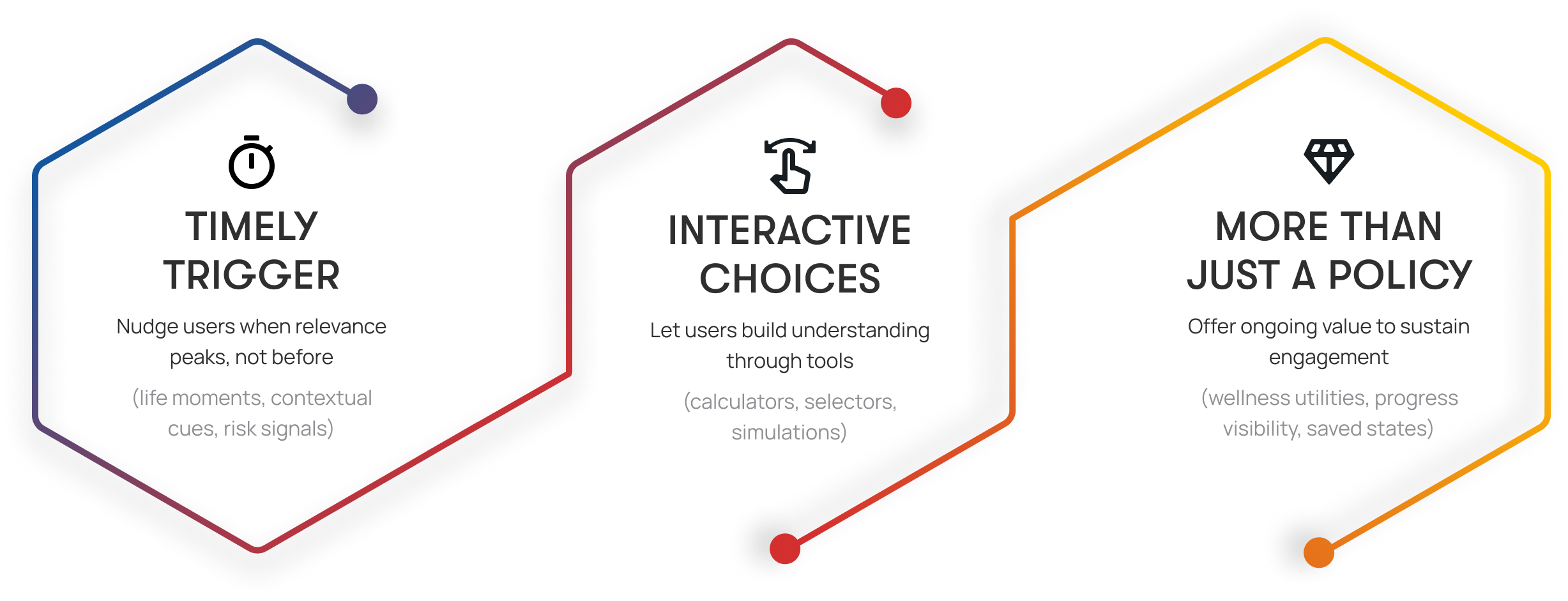
We distilled all insights into three actionable themes:
Interactive Choice
Users engage when they can explore, compare, and customise outcomes
Timely Triggers
Intent activates only when relevance aligns with life context
Engagement sustains when value exists outside claims
Value Beyond the Policy
Evolving Insurance Experiences with the TIM Framework
Design Strategy
TIM framework detailed case study is captured in this article
These themes consistently explained user behaviour across Term, Health and ULIP.


STRATEGIC DESIGN DIRECTION
Three pillars of the framework
TIM = Trigger → Interact → More
FROM STRATEGY → EXECUTION
We applied the TIM framework end-to-end on the Health Insurance journey to validate it in practice.

Strategy: Behavioural framework (TIM)
Planning: Mapped journey against TIM states
Execution: Designed tools, triggers and progress loops
Validation: Internal critiques and early dipstick testing
This moved TIM from concept to production-ready design logic.
TESTING THE FRAMEWORK
Ideation workshop
We pressure-tested TIM through a structured ideation workshop on Health Insurance, combining all three behavioural levers. Early reviews showed stronger engagement and clearer progression compared to the previous flow.
From Insights → Framework → Prototypes
The full Health journey was planned using a clear flow:
Insights → Framework → Ideation → Prioritisation → Prototyping → Testing
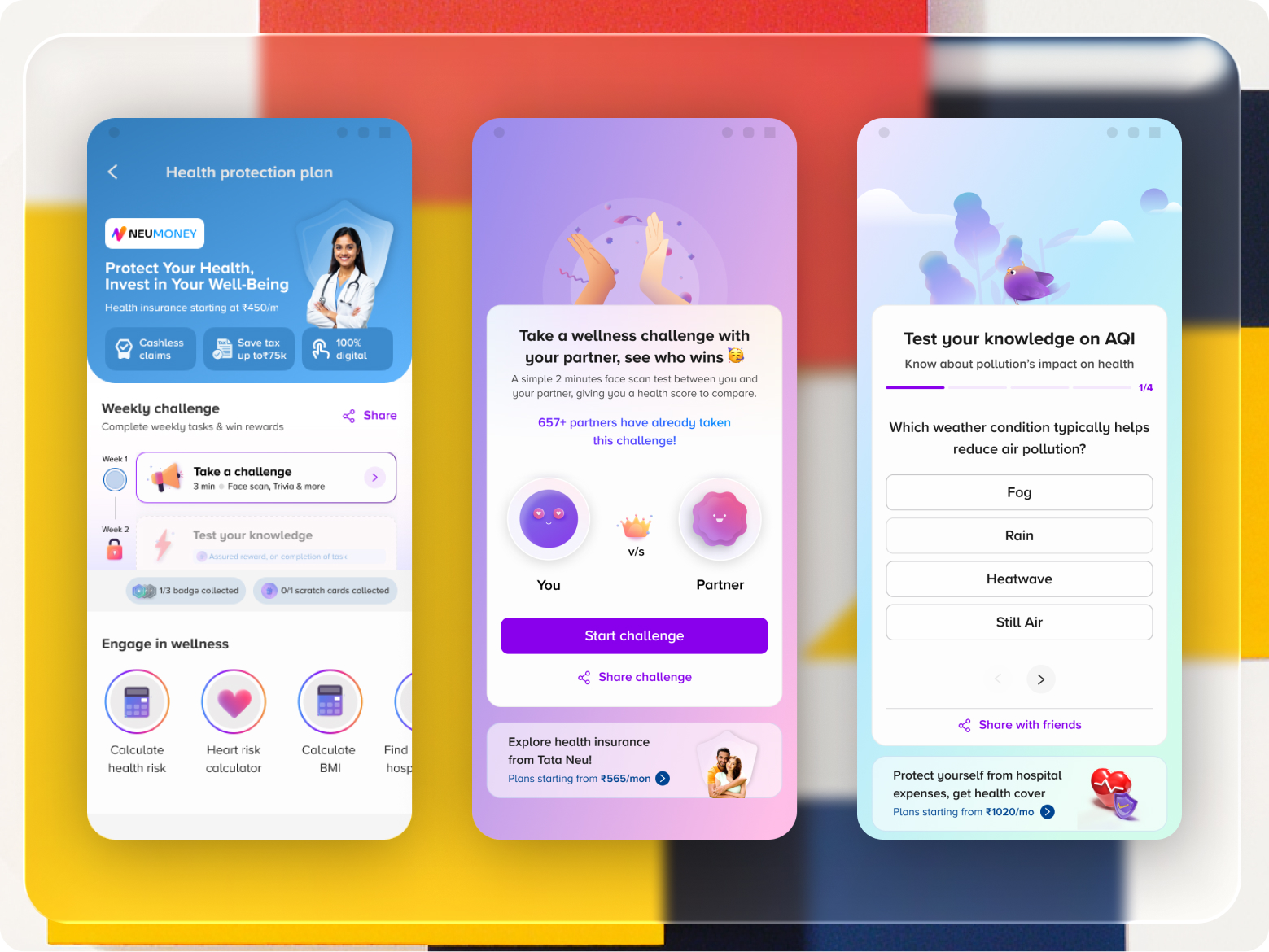
Redesigned acquisition → FTUX → repeat journeys using TIM, simplifying decisions and increasing activation.
UX DESIGN


OUTCOME & EXPECTED IMPACT
Early signals indicated:
Deeper exploration before drop-off
Higher interaction with tools vs static content
Improved progression for returning users
Reduced dependency on monetary incentives
The core impact: intent activation became systematic, not accidental.
MY ROLE & SCOPE
ROLE: Principal designer - Behaviour led strategy
DURATION: 3 months · Cross-functional squad
SCOPE: Created TIM framework · Research synthesis · Strategy → execution mapping · Experience direction
COLLOBORATION: Product, Research, Growth, Engineering
Closing Note
TIM is not a campaign idea or a UI pattern.
It’s a reusable behavioural system designed to evolve with changing user intent across insurance categories.
MORE PROJECTS TO EXPLORE
Similar work and additional learning in other projects

ARVIND SETHIA - FEATURED PROJECT
TIM Framework
Intent Activation Across Insurance
A behaviour-first framework to activate low-intent insurance users across Term, Health and ULIP.
Strategy Design
Strategy Design
WHY THIS WORK MATTERED
Insurance intent was collapsing because experiences weren’t designed for how users actually decide.
Problem → Opportunity
Increase activation from anonymous users
~50% of users landing on the product page are anonymous
Create ongoing engagement that converts to leads
>70% users drop on landing
pages w/o starting the journey
Design a retention flow that holds attention
Logged-in users restarted instead of progressing
Anonymous users convert
1/10th the rate of conversion of logged-in users
Strengthen Tata Neu Insurance awareness
APPROACH
We had deep research across Term, Health and ULIP, but it lived in silos.
The first step was to synthesise insights across products and look for behavioural patterns, not category-specific problems.

Across all three products, the same behaviours repeated:
Users hesitate before committing, Want control while exploring, Act only when timing feels relevant, and Disengage when value isn’t visible.
Competitor analysis reinforced this.
The industry was moving away from education-heavy content and toward tools, simplification, and wellness-led engagement. These signals aligned with our research.
We clustered all insights using affinity mapping and distilled them into three repeatable behavioural levers.Those levers became the foundation of the TIM framework.
WHAT WE LEARNED
Behavioural drivers that consistently shaped user decisions:
1
Clarity Before Commitment
Unclear coverage blocks early decision-making
2
Control Drives Trust
Users trust outcomes they can manipulate
3
Timing Shapes Intent
Context matters more than funnel design
4
Friction Feels Risky
Irreversible steps trigger abandonment
5
Value Must Be Continuous
Rare-use products demand present value
Trends & Competitive Signals
TREND 1
Simplification Over Education
Long-form education is fading
TREND 2
Familiar Faces Reduce Anxiety
Celebrity cues lower perceived complexity
TREND 3
Wellness as Engagement Layer
Insurance bundled with lifestyle value
TREND 4
Tools Outperform Content
Interaction beats passive consumption

Synthesis — The Behavioural Backbone
We distilled all insights into three actionable themes:
Interactive Choice
Users engage when they can explore, compare, and customise outcomes
Timely Triggers
Intent activates only when relevance aligns with life context
Engagement sustains when value exists outside claims
Value Beyond the Policy
Evolving Insurance Experiences with the TIM Framework
Design Strategy
TIM framework detailed case study is captured in this article
These themes consistently explained user behaviour across Term, Health and ULIP.

STRATEGIC DESIGN DIRECTION
Three pillars of the framework
TIM = Trigger → Interact → More
FROM STRATEGY → EXECUTION
We applied the TIM framework end-to-end on the Health Insurance journey to validate it in practice.
Strategy: Behavioural framework (TIM)
Planning: Mapped journey against TIM states
Execution: Designed tools, triggers and progress loops
Validation: Internal critiques and early dipstick testing
This moved TIM from concept to production-ready design logic.
TESTING THE FRAMEWORK
Ideation workshop
We pressure-tested TIM through a structured ideation workshop on Health Insurance, combining all three behavioural levers. Early reviews showed stronger engagement and clearer progression compared to the previous flow.
From Insights → Framework → Prototypes
The full Health journey was planned using a clear flow:
Insights → Framework → Ideation → Prioritisation → Prototyping → Testing
Health Insurance via TIM — Journey Reimagined
Redesigned acquisition → FTUX → repeat journeys using TIM, simplifying decisions and increasing activation.
UX DESIGN
OUTCOME & EXPECTED IMPACT
Early signals indicated:
Deeper exploration before drop-off
Higher interaction with tools vs static content
Improved progression for returning users
Reduced dependency on monetary incentives
The core impact: intent activation became systematic, not accidental.
MY ROLE & SCOPE
ROLE: Principal designer - Behaviour led strategy
DURATION: 2 months
SCOPE: Created TIM framework · Research synthesis · Strategy → execution mapping · Experience direction
COLLABORATION: Product, Research, Growth, Engineering
Closing Note
TIM is not a campaign idea or a UI pattern.
It’s a reusable behavioural system designed to evolve with changing user intent across insurance categories.
MORE PROJECTS TO EXPLORE
Similar work and additional learning in other projects
ARVIND SETHIA - FEATURED PROJECT
TIM Framework
Intent Activation Across Insurance
A behaviour-first framework to activate low-intent insurance users across Term, Health and ULIP.
DESIGN STRATEGY
behavioural UX
WHY THIS WORK MATTERED
Insurance intent was collapsing because experiences weren’t designed for how users actually decide.
Problem → Opportunity
Increase activation from anonymous users
~50% of users landing on the product page are anonymous
Create ongoing engagement that converts to leads
>70% users drop on landing
pages w/o starting the journey
Design a retention flow that holds attention
Logged-in users restarted instead of progressing
Strengthen Tata Neu Insurance awareness
Anonymous users convert
1/10th the rate of conversion of logged-in users
APPROACH
We had deep research across Term, Health and ULIP, but it lived in silos.
The first step was to synthesise insights across products and look for behavioural patterns, not category-specific problems.
Across all three products, the same behaviours repeated:
Users hesitate before committing, Want control while exploring, Act only when timing feels relevant, and Disengage when value isn’t visible.
Competitor analysis reinforced this.
The industry was moving away from education-heavy content and toward tools, simplification, and wellness-led engagement. These signals aligned with our research.
We clustered all insights using affinity mapping and distilled them into three repeatable behavioural levers.Those levers became the foundation of the TIM framework.
WHAT WE LEARNED
Core User Insights (Cross-Product)
1
Clarity Before Commitment
Unclear coverage blocks early decision-making
2
Control Drives Trust
Users trust outcomes they can manipulate
3
Timing Shapes Intent
Context matters more than funnel design
4
Friction Feels Risky
Irreversible steps trigger abandonment
5
Value Must Be Continuous
Rare-use products demand present value
Trends & Competitive Signals
TREND 1
Simplification Over Education
Long-form education is fading
TREND 2
Familiar Faces Reduce Anxiety
Celebrity cues lower perceived complexity
TREND 3
Wellness as Engagement Layer
Insurance bundled with lifestyle value
TREND 4
Tools Outperform Content
Interaction beats passive consumption

Synthesis — The Behavioural Backbone
We distilled all insights into three actionable themes:
Interactive Choice
Users engage when they can explore, compare, and customise outcomes
Timely Triggers
Intent activates only when relevance aligns with life context
Value Beyond the Policy
Engagement sustains when value exists outside claims

Evolving Insurance Experiences with the TIM Framework
Design Strategy
TIM framework detailed case study is captured in this article
These themes consistently explained user behaviour across Term, Health and ULIP.
STRATEGIC DESIGN DIRECTION
Three pillars of the framework
TIM = Trigger → Interact → More
FROM STRATEGY → EXECUTION
We applied the TIM framework end-to-end on the Health Insurance journey to validate it in practice.
Strategy: Behavioural framework (TIM)
Planning: Mapped journey against TIM states
Execution: Designed tools, triggers and progress loops
Validation: Internal critiques and early dipstick testing
This moved TIM from concept to production-ready design logic.
TESTING THE FRAMEWORK
Ideation workshop
We pressure-tested TIM through a structured ideation workshop on Health Insurance, combining all three behavioural levers. Early reviews showed stronger engagement and clearer progression compared to the previous flow.
From Insights → Framework → Prototypes
The full Health journey was planned using a clear flow:
Insights → Framework → Ideation → Prioritisation → Prototyping → Testing
The card captures how TIM translates directly into experience decisions.
UX DESIGN
OUTCOME & EXPECTED IMPACT
Early signals indicated:
Deeper exploration before drop-off
Higher interaction with tools vs static content
Improved progression for returning users
Reduced dependency on monetary incentives
The core impact: intent activation became systematic, not accidental.
MY ROLE & SCOPE
ROLE: Principal designer - Behaviour led strategy
DURATION: 3 months
SCOPE: Created TIM framework · Research synthesis · Strategy → execution mapping · Experience direction
COLLABORATION: Product, Research, Growth, Engineering
Closing Note
TIM is not a campaign idea or a UI pattern.
It’s a reusable behavioural system designed to evolve with changing user intent across insurance categories.
MORE PROJECTS TO EXPLORE
Similar work and additional learning in other projects