

ARVIND SETHIA - BONUS PROJECT
Fixed Deposits (FD)
Data-led funnel optimization under regulatory constraints
UX execution
LIVE PRODUCT
Role: Lead Designer (Product × Growth × Compliance)North-star metric: FD booking success rate
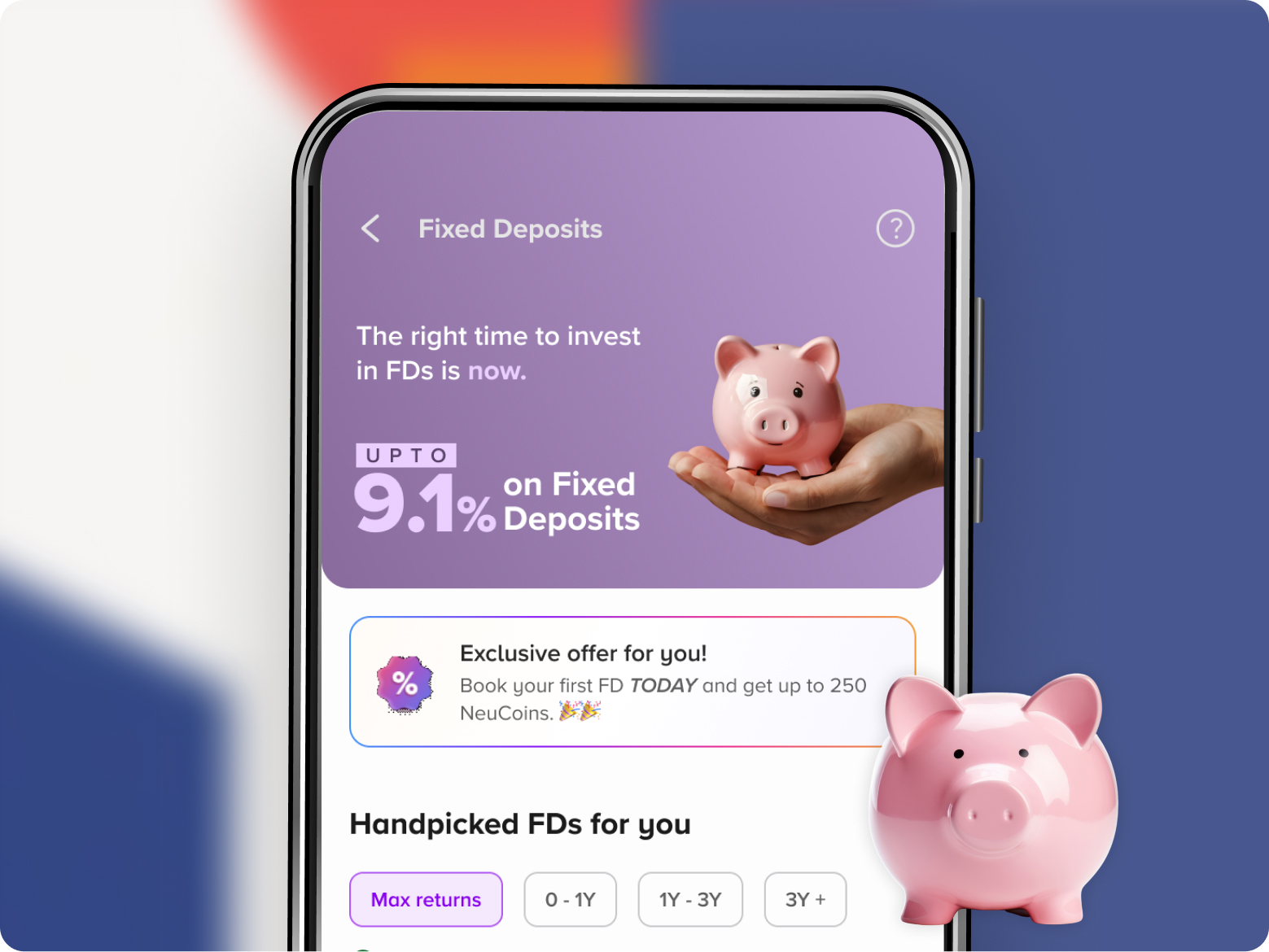
CONTEXT
AI changed user expectations — but not through in-app chatbots.
This project focused on improving FD booking success rate by repairing high-friction decision moments, using funnel data and continuous iteration — while operating under strict compliance constraints.
PROBLEM
Funnel analysis showed a severe commitment drop, not a discovery issue.

Strong traffic into FD Explore
Only ~15% attempted booking
End-to-end success below 1%
Insight


But as a silent, intelligent collaborator
DESIGN STRATEGY

CC-on-UPI linkage
Optimize for scan-based comparison
Make trust signals explicit
Reduce decision friction, not persuasion
Design with compliance, not around it
KEY INTERVENTIONS
Peripheral (reinforces trust + preference)
Problem:
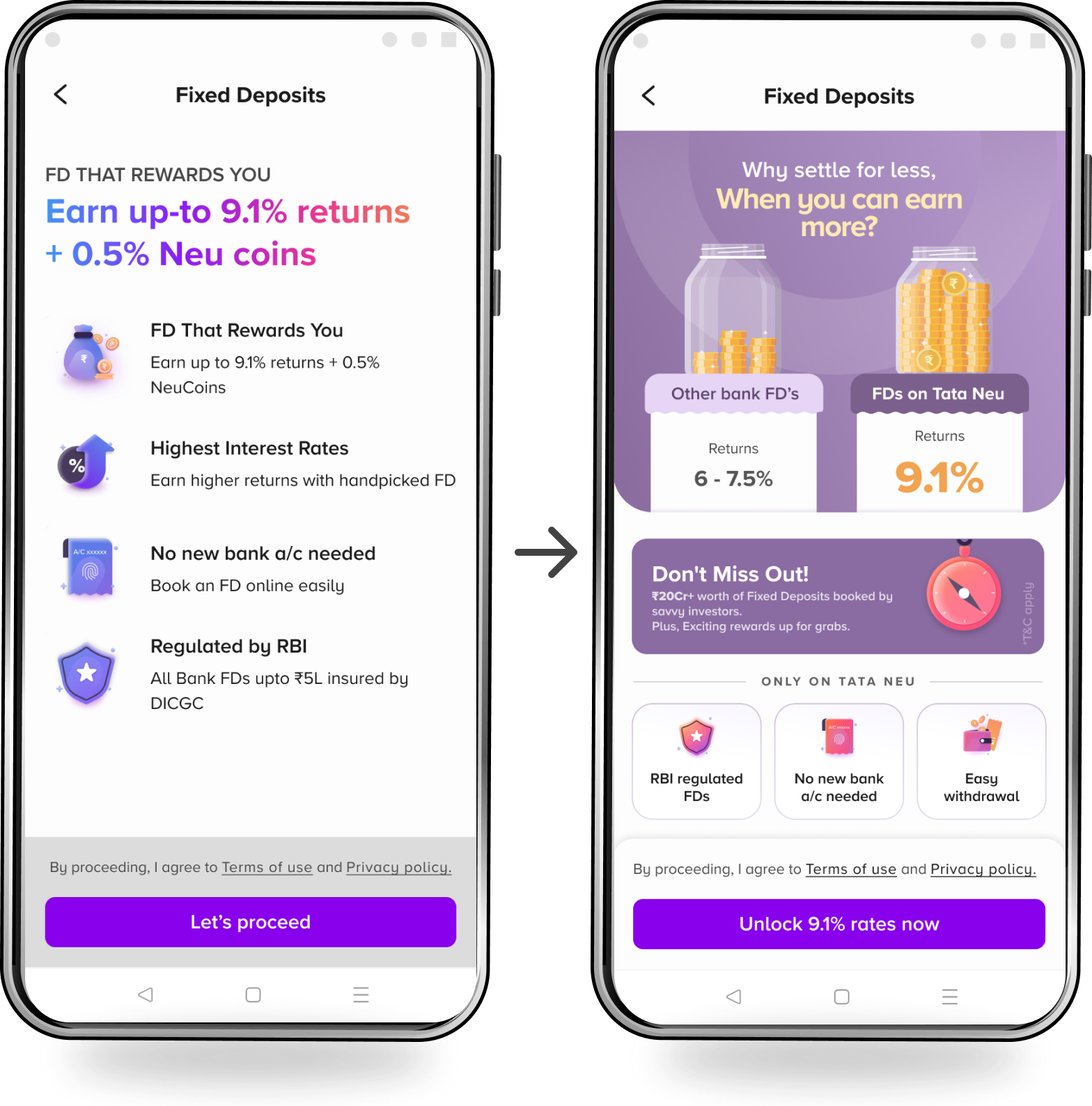
Compliance-mandated consent appeared at journey entry, acting as a psychological blocker.
Iteration path
Entry-level consent → value-led consent → buried consent
Final state: consent moved closer to booking / before KYC
Outcome:
Consent exits dropped sharply
FD Explore traffic increased ~2–3× month-on-month
Exploration unlocked before commitment
Consent shifted from an entry gate to a confirmation step.
Peripheral (reinforces trust + preference)
Problem:
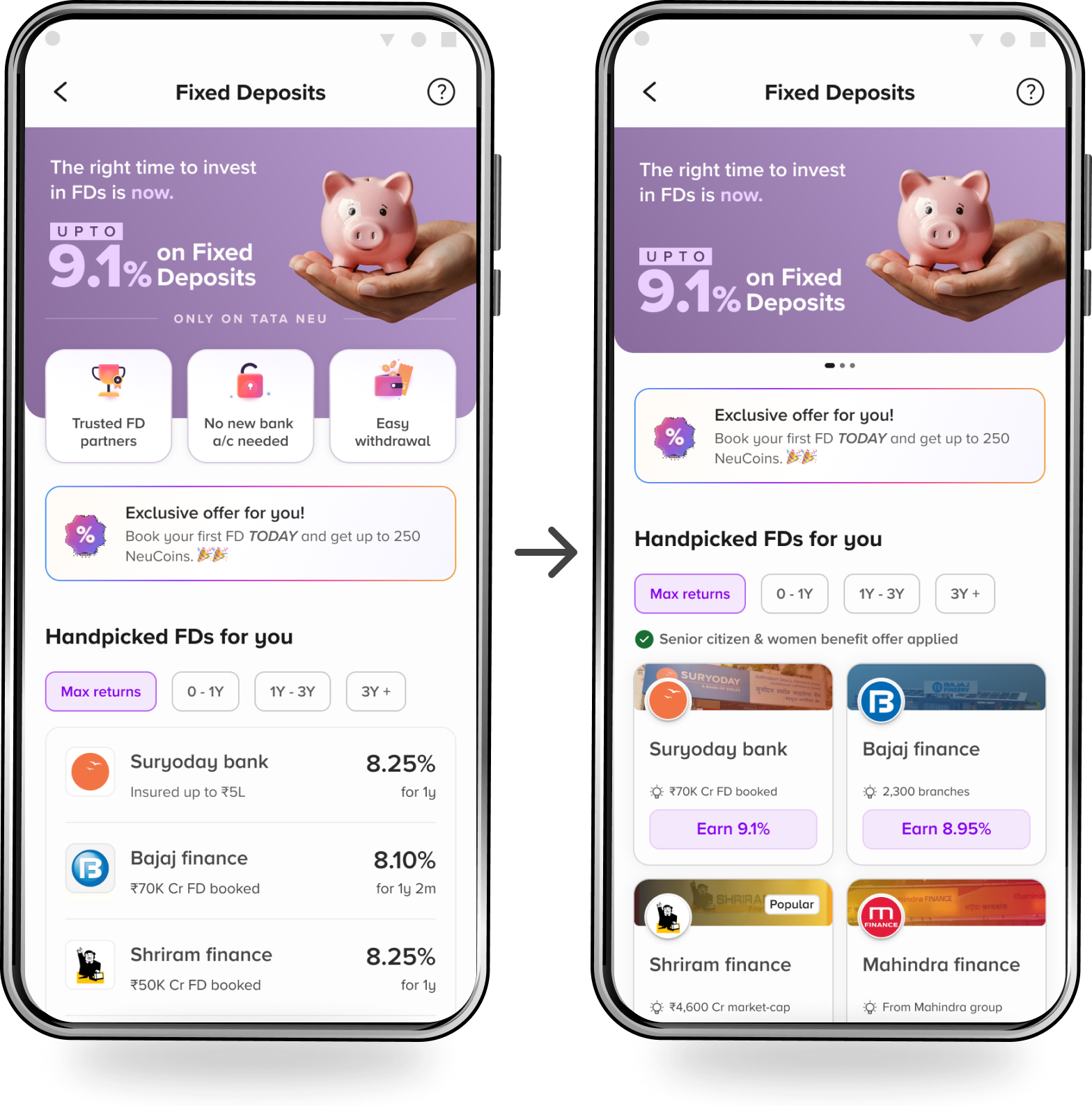
List-based discovery forced reading, slowed comparison, and lacked trust cues — especially for smaller banks.
Design changes
Shifted from list to card-based layout
Highlighted returns directly in the CTA
Increased bank identity prominence
Added trust signals (physical presence, scale)
Optimized density to surface more options above the fold
Outcome:
Consistent downstream exploration lift
Increase in average FD amount
Reduced avoidance of high-return, lesser-known issuers
Designed the discovery surface as a decision moment, not a catalogue.
Peripheral (reinforces trust + preference)
Design changes
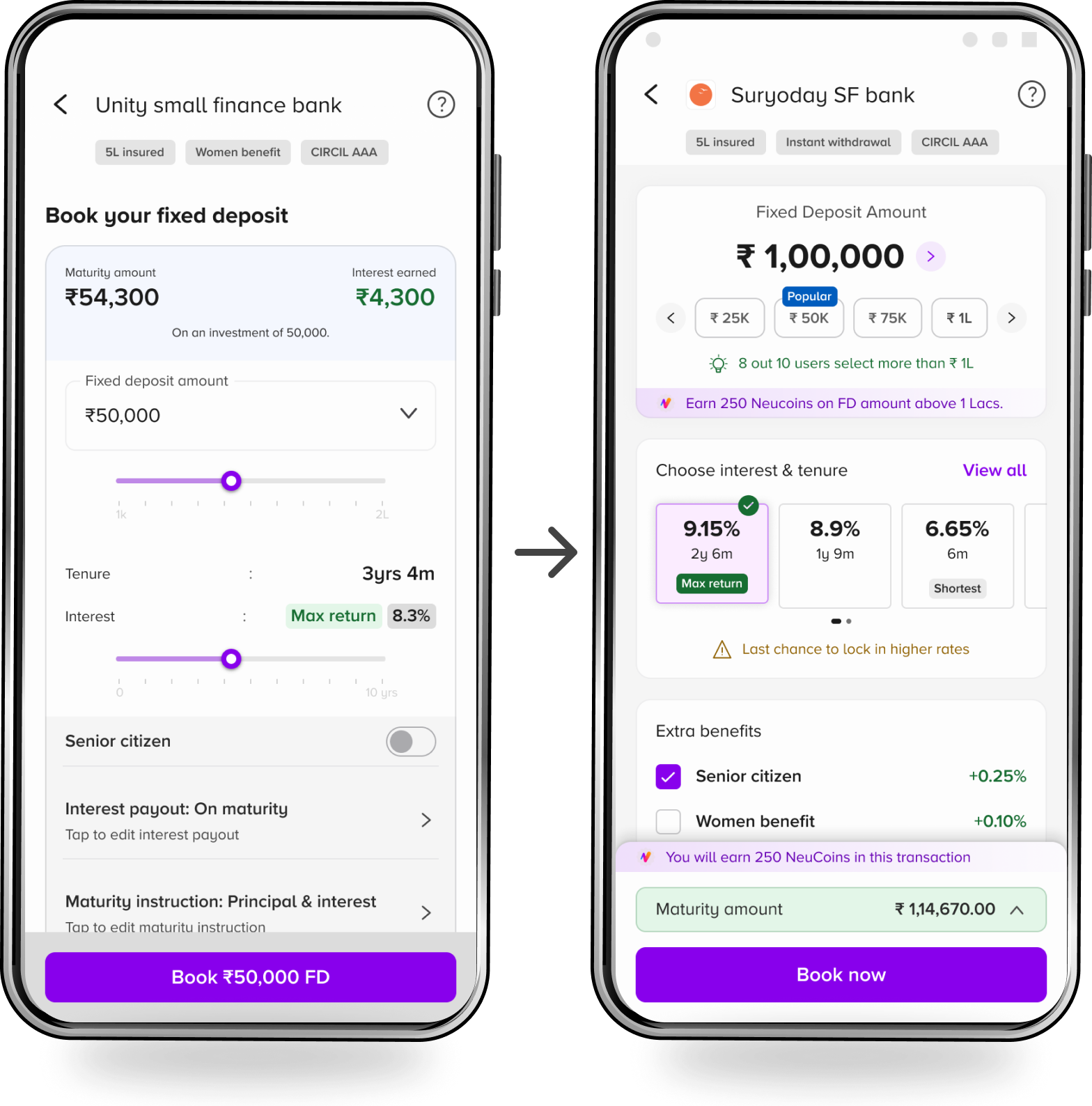
Sliders were slow and error-prone
Calculator buried below content encouraged “play,” not commitment
Design changes
Moved calculator to the top
Replaced sliders with chips and +/-
Enabled real-time return feedback
Outcome:
Faster time-to-decision
Higher booking attempts
Sustained increase in Net FDs
Reduced calculator play; increased commitment.
Peripheral (reinforces trust + preference)
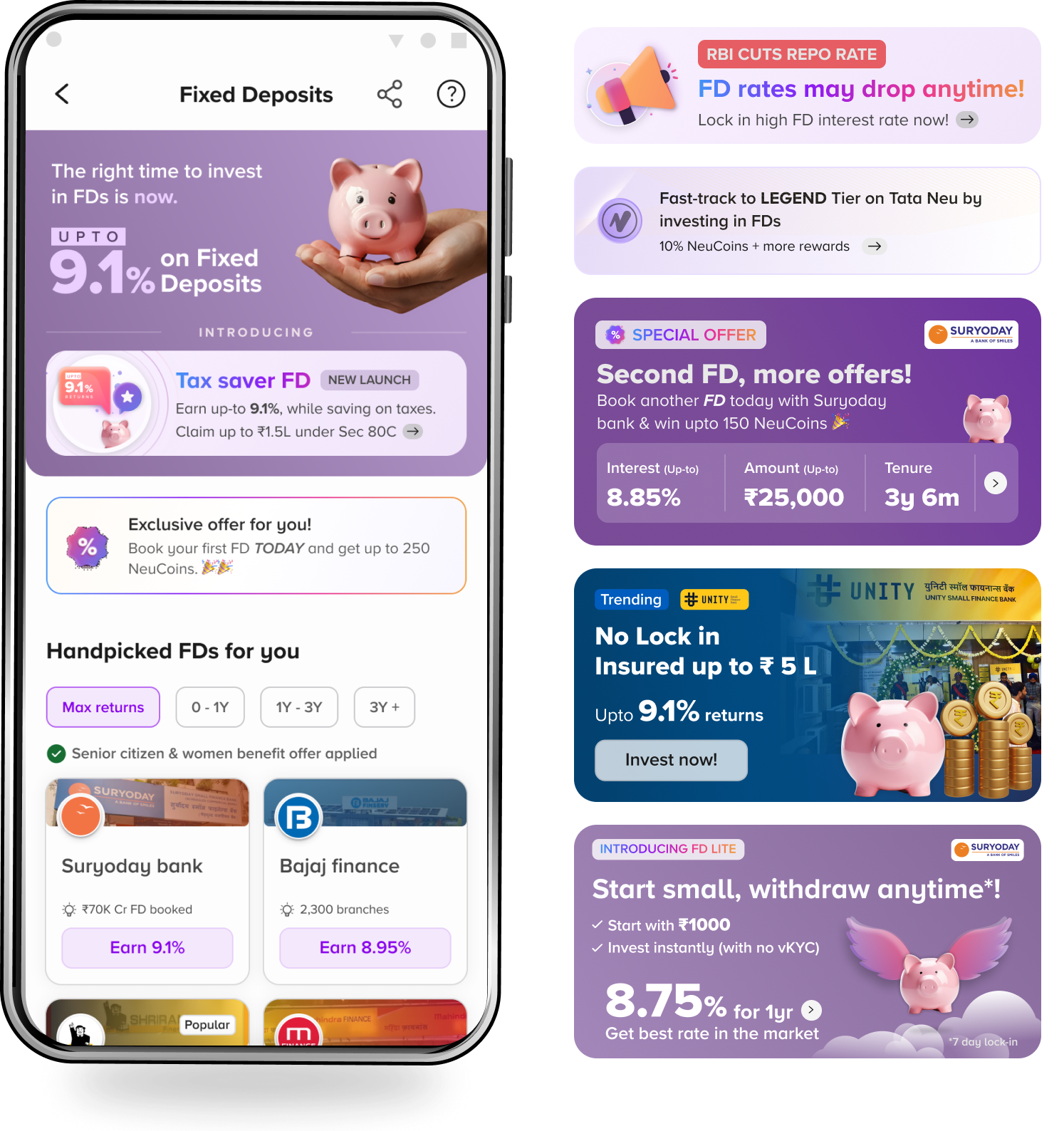
Collaborated with Growth to operationalize campaigns through UX, not overlays.
Repo-rate FOMO
Low-entry FDs (₹5K+) & Short tenure options
Issuer-based rewards
Design changes
PDP banner slot
Repeat-user widget below dashboard
A/B tested carousel vs single banner (single won)
Impact
Supported ₹500cr annual target
Achieved ₹350cr despite rate compression and competition
Growth worked only after core decision friction was fixed.
WHAT THIS PROJECT DEMONSTRATES
Funnel-level diagnosis & prioritization
Structural journey redesign under compliance
Data-led iteration on a live product
Design × Growth collaboration with clear ownership
This case complements strategy-heavy work by showing execution discipline on a live product: real users, real constraints, compounding impact.
MORE PROJECTS TO EXPLORE
Similar work and additional learning in other projects
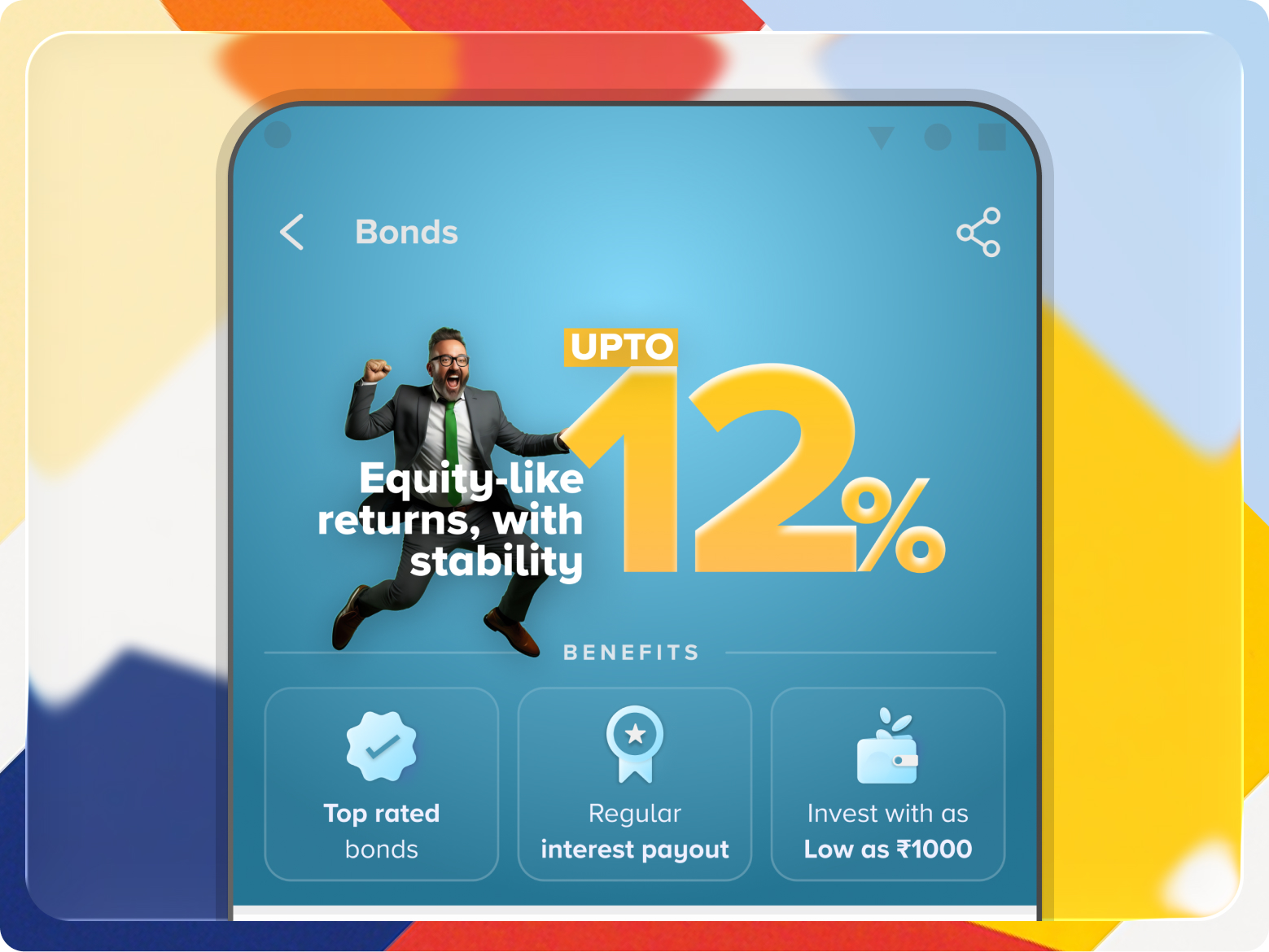
Bonds
Owning the decision surface to drive category adoption
UX/UI Execution
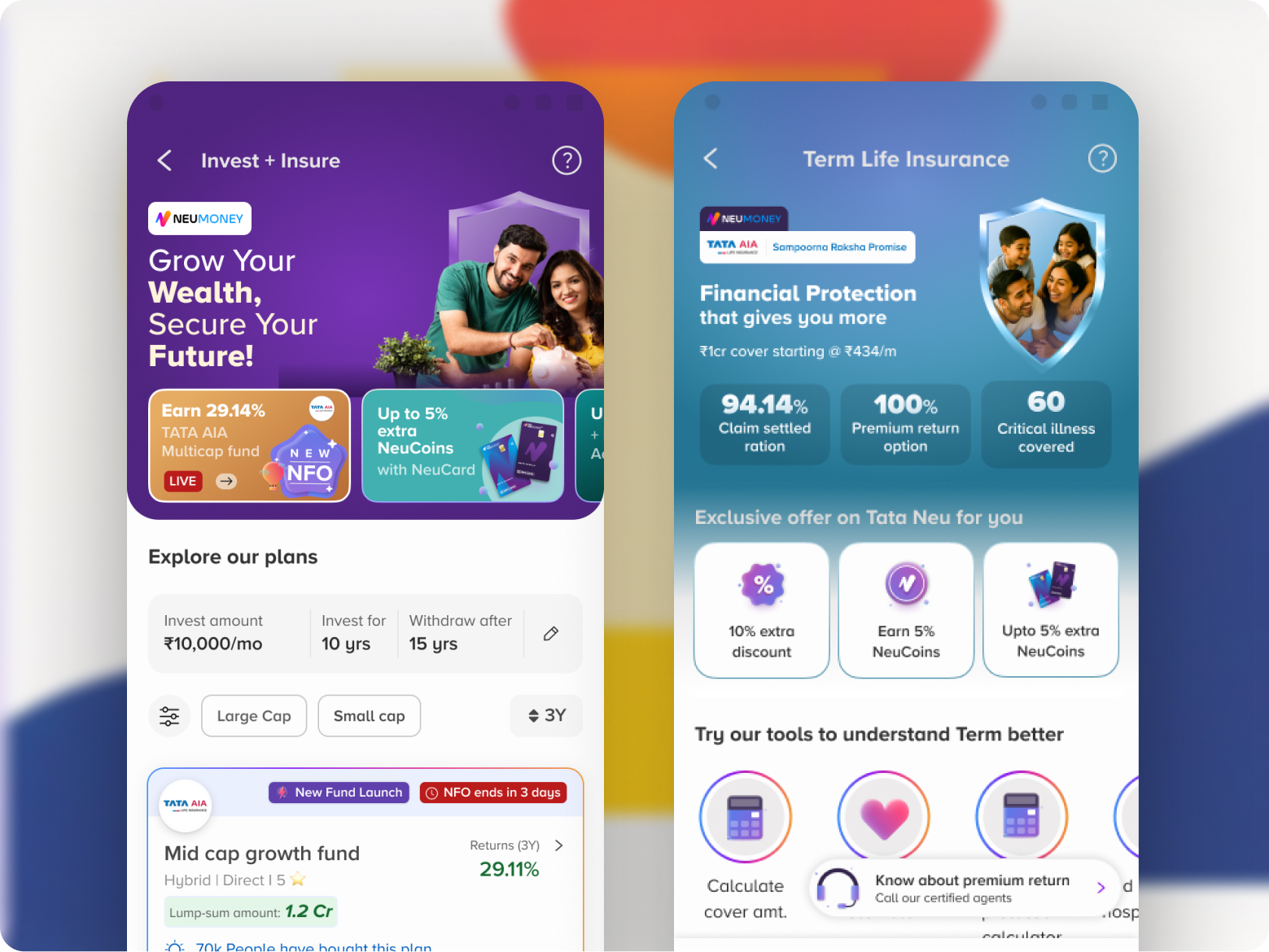
Rebuilding Life Insurance on Tata Neu
From Redirection Chaos to Native, End-to-End Ownership
UX/UI Execution
ARVIND SETHIA - BONUS PROJECT
Fixed Deposits (FD)
Data-led funnel optimization under regulatory constraints
UX execution
LIVE PRODUCT
Role: Lead Designer (Product × Growth × Compliance)North-star metric: FD booking success rate
CONTEXT
AI changed user expectations — but not through in-app chatbots.
This project focused on improving FD booking success rate by repairing high-friction decision moments, using funnel data and continuous iteration — while operating under strict compliance constraints.
PROBLEM
Funnel analysis showed a severe commitment drop, not a discovery issue.
Strong traffic into FD Explore
Only ~15% attempted booking
End-to-end success below 1%
Insight
But as a silent, intelligent collaborator
DESIGN STRATEGY
CC-on-UPI linkage
Optimize for scan-based comparison
Make trust signals explicit
Reduce decision friction, not persuasion
Design with compliance, not around it
KEY INTERVENTIONS
Consent journey restructuring (structural fix)
Problem:
Compliance-mandated consent appeared at journey entry, acting as a psychological blocker.
Iteration path
Entry-level consent → value-led consent → buried consent
Final state: consent moved closer to booking / before KYC
Outcome:
Consent exits dropped sharply
FD Explore traffic increased ~2–3× month-on-month
Exploration unlocked before commitment
Consent shifted from an entry gate to a confirmation step.
FD Discovery: Designing for confident comparison
Problem:
List-based discovery forced reading, slowed comparison, and lacked trust cues — especially for smaller banks.
Design changes
Shifted from list to card-based layout
Highlighted returns directly in the CTA
Increased bank identity prominence
Added trust signals (physical presence, scale)
Optimized density to surface more options above the fold
Outcome:
Consistent downstream exploration lift
Increase in average FD amount
Reduced avoidance of high-return, lesser-known issuers
Designed the discovery surface as a decision moment, not a catalogue.
FD Details & Calculator: Reducing decision friction
Design changes
Sliders were slow and error-prone
Calculator buried below content encouraged “play,” not commitment
Design changes
Moved calculator to the top
Replaced sliders with chips and +/-
Enabled real-time return feedback
Outcome:
Faster time-to-decision
Higher booking attempts
Sustained increase in Net FDs
Reduced calculator play; increased commitment.
Growth enablement (design-led)
Collaborated with Growth to operationalize campaigns through UX, not overlays.
Repo-rate FOMO
Low-entry FDs (₹5K+) & Short tenure options
Issuer-based rewards
Design changes
PDP banner slot
Repeat-user widget below dashboard
A/B tested carousel vs single banner (single won)
Impact
Supported ₹500cr annual target
Achieved ₹350cr despite rate compression and competition
Growth worked only after core decision friction was fixed.
WHAT THIS PROJECT DEMONSTRATES
Funnel-level diagnosis & prioritization
Structural journey redesign under compliance
Data-led iteration on a live product
Design × Growth collaboration with clear ownership
This case complements strategy-heavy work by showing execution discipline on a live product: real users, real constraints, compounding impact.
MORE PROJECTS TO EXPLORE
Similar work and additional learning in other projects

Lorem ipsum title of my project, and a long name
Owning the decision surface to drive category adoption
UX/UI Execution


Lorem ipsum title of my project, and a long name
Designing Term & ULIP journeys to reduce friction, improve clarity, and drive conversion.
UX/UI Execution
ARVIND SETHIA - BONUS PROJECT
Fixed Deposits (FD)
Data-led funnel optimisation under regulatory constraints
UX execution
LIVE PRODUCT
Role: Lead Designer (Product × Growth × Compliance)North-star metric: FD booking success rate
CONTEXT
Fixed Deposits are a mature, low-learning product.
Users don’t need education — they need fast comparison, trust, and confidence to commit.
This project focused on improving FD booking success rate by repairing high-friction decision moments, using funnel data and continuous iteration — while operating under strict compliance constraints.
PROBLEM
Funnel analysis showed a severe commitment drop, not a discovery issue.
Strong traffic into FD Explore
Only ~15% attempted booking
End-to-end success below 1%
Insight
Users were interested, but dropped when forced to commit before they could compare or trust the product.
DESIGN STRATEGY
Fix journey structure before UI
Optimize for scan-based comparison
Make trust signals explicit
Reduce decision friction, not persuasion
Design with compliance, not around it
KEY INTERVENTIONS
Consent journey restructuring (structural fix)
Problem:
Compliance-mandated consent appeared at journey entry, acting as a psychological blocker.
Iteration path
Entry-level consent → value-led consent → buried consent
Final state: consent moved closer to booking / before KYC
Outcome:
Consent exits dropped sharply
FD Explore traffic increased ~2–3× month-on-month
Exploration unlocked before commitment
Consent shifted from an entry gate to a confirmation step.
FD Discovery: Designing for confident comparison
Problem:
List-based discovery forced reading, slowed comparison, and lacked trust cues — especially for smaller banks.
Design changes
Shifted from list to card-based layout
Highlighted returns directly in the CTA
Increased bank identity prominence
Added trust signals (physical presence, scale)
Optimised density to surface more options above the fold
Outcome:
Consistent downstream exploration lift
Increase in average FD amount
Reduced avoidance of high-return, lesser-known issuers
Designed the discovery surface as a decision moment, not a catalogue.
FD Details & Calculator: Reducing decision friction
Problems
Sliders were slow and error-prone
Calculator buried below content encouraged “play,” not commitment
Design changes
Moved calculator to the top
Replaced sliders with chips and +/-
Enabled real-time return feedback
Outcome:
Faster time-to-decision
Higher booking attempts
Sustained increase in Net FDs
Reduced calculator play; increased commitment.
Growth enablement (design-led)
Collaborated with Growth to operationalize campaigns through UX, not overlays.
Repo-rate FOMO
Low-entry FDs (₹5K+) & Short tenure options
Issuer-based rewards
Execution
PDP banner slot
Repeat-user widget below dashboard
A/B tested carousel vs single banner (single won)
Impact
Supported ₹500cr annual target
Achieved ₹350cr despite rate compression and competition
Growth worked only after core decision friction was fixed.
WHAT THIS PROJECT DEMONSTRATES
Funnel-level diagnosis & prioritisation
Structural journey redesign under compliance
Data-led iteration on a live product
Design × Growth collaboration with clear ownership
This case complements strategy-heavy work by showing execution discipline on a live product: real users, real constraints, compounding impact.
MORE PROJECTS TO EXPLORE
Similar work and additional learning in other projects
Bonds
Owning the decision surface to drive category adoption
UX/UI Execution
Rebuilding Life Insurance on Tata Neu
From Redirection Chaos to Native, End-to-End Ownership
UX/UI Execution